
Terrebonne Parish Criminal Court Cases
The Terrebonne Parish Clerk of Court keeps the filings for the 32nd Judicial District Court. Its six divisions hear Terrebonne Parish felonies and state misdemeanors. The court file begins when the district attorney files a bill of information or a grand jury returns an indictment. From that point, the docket can show hearings, motions, plea activity, judgment, sentence, costs, and later probation or expungement proceedings. The clerk, rather than the sheriff or district attorney, is the main custodian for those judicial records.
Houma City Court has a separate, limited criminal jurisdiction that includes city ordinances, traffic matters, and some misdemeanors. A bench warrant issued there may not appear as a 32nd Judicial District Court result. Appeals from the district court go to the Louisiana First Circuit Court of Appeal, while the Louisiana Supreme Court maintains its own appellate docket and rules. The court that created the record should receive the copy request.
The clerk's official home page provides the starting point for Terrebonne Parish court services.
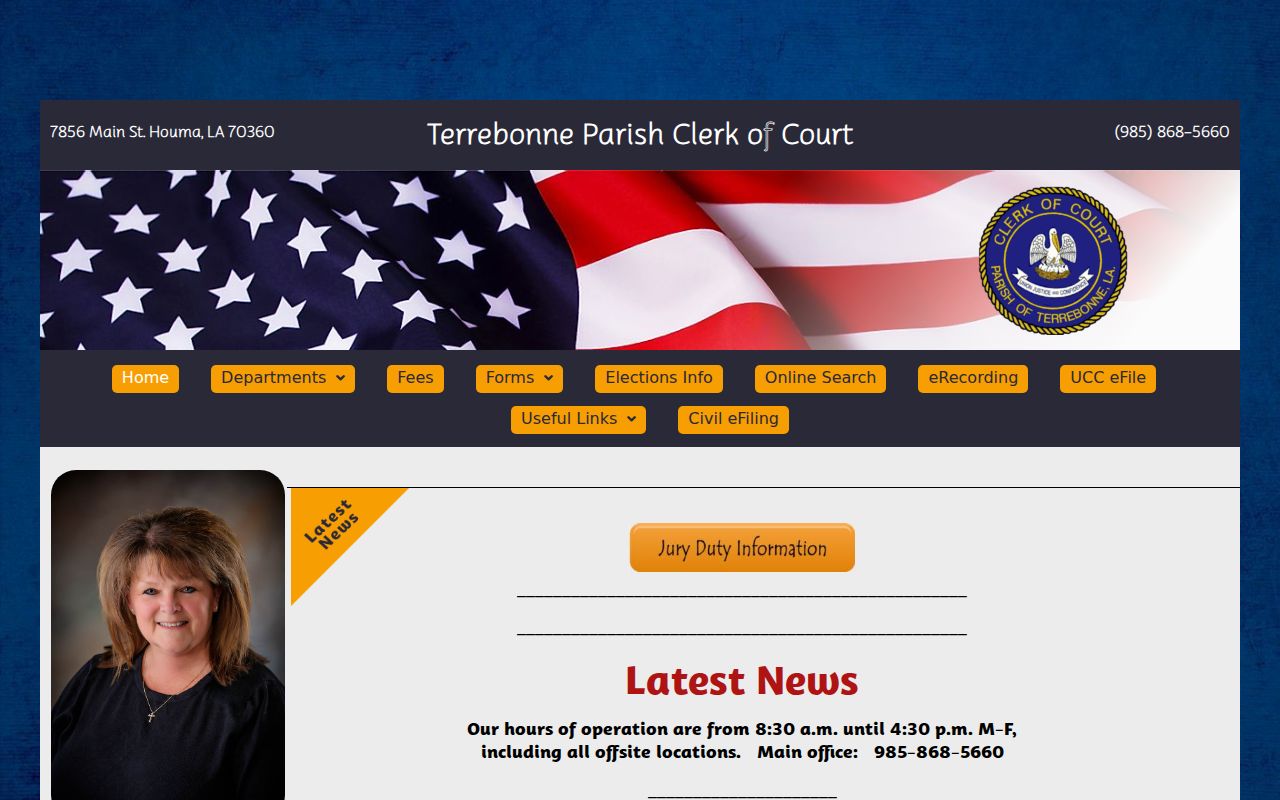
Use it to confirm current clerk information before relying on an older directory entry.
Terrebonne Criminal eSearch Access
The clerk's protected criminal eSearch is account based. Its public sign-in screen requires a user ID and case-sensitive password and offers both account creation and password recovery. The portal also calls for HTML5, cookies, JavaScript, pop-ups, and Adobe Reader. Those requirements matter when a search button or document image seems unresponsive. The index is a court-case tool, not a statewide rap sheet or a live custody roster.
The official sign-in screen shows the gate a reader must pass before reaching Terrebonne Parish criminal case details.
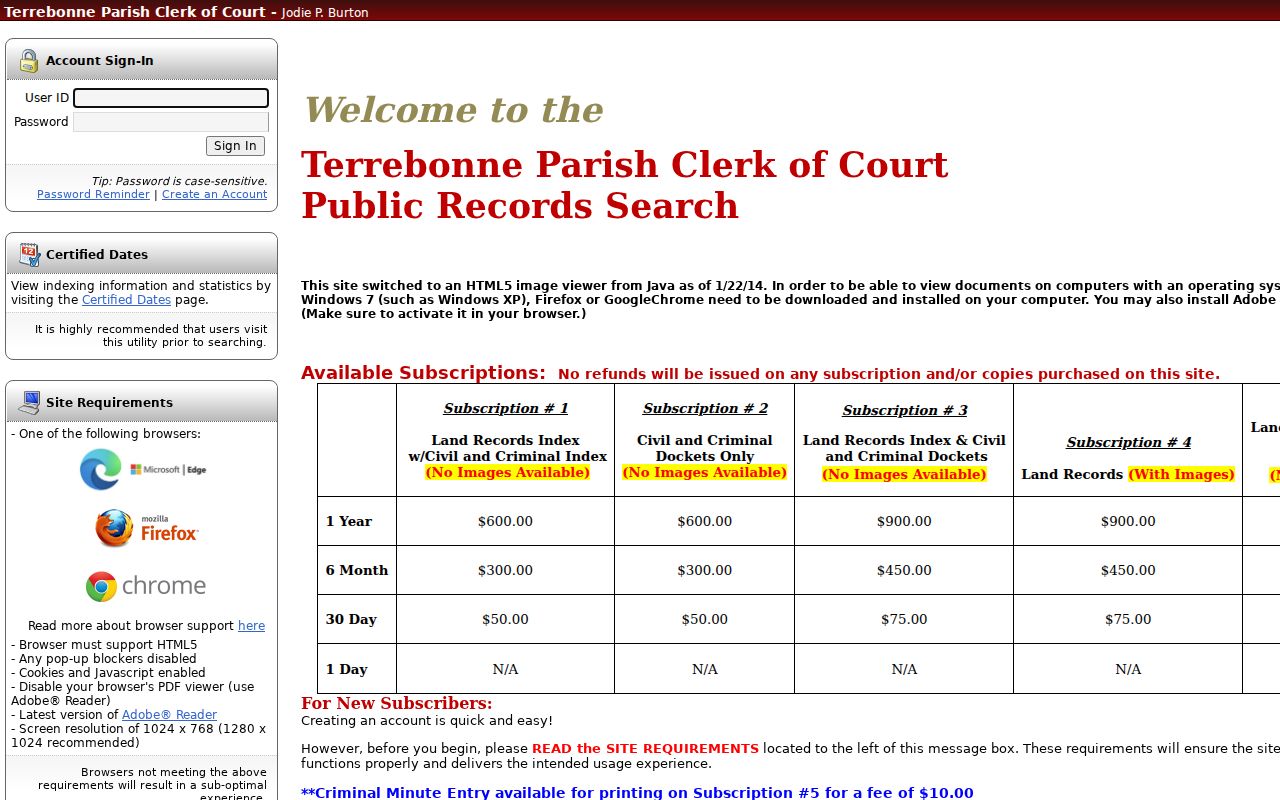
Creating an account does not guarantee that every indexed document image is free or available online.
Searching Terrebonne Parish Case Records
Begin with the exact legal name, then use a known docket number when available. Similar names should be checked against the filing year, charges, division, and case status. The portal's publicly documented controls are limited because the detailed query sits behind sign-in.
- Open criminal eSearch, create an account or sign in, and check the Certified Dates link.
- Choose the criminal case-name function and enter the legal name or known docket number.
- Compare filing dates, charges, and divisions so a namesake is not mistaken for the correct party.
- Open the docket detail and note the status, disposition, next hearing, and available document images.
- Call the clerk for an older case, a missing image, or a certified copy of the outcome.
| Field or Control | Type | Required | Use |
|---|---|---|---|
| User ID | Text | Yes | Account credential for protected search |
| Password | Password | Yes | Case-sensitive credential |
| Case Name | Protected tab | After login | Party-name query; post-login fields are not publicly listed |
| Certified Dates | Link | No | Confirms the current index coverage |
| Account tools | Links | No | Create an Account or Password Reminder |
Terrebonne Case Coverage Since 1994
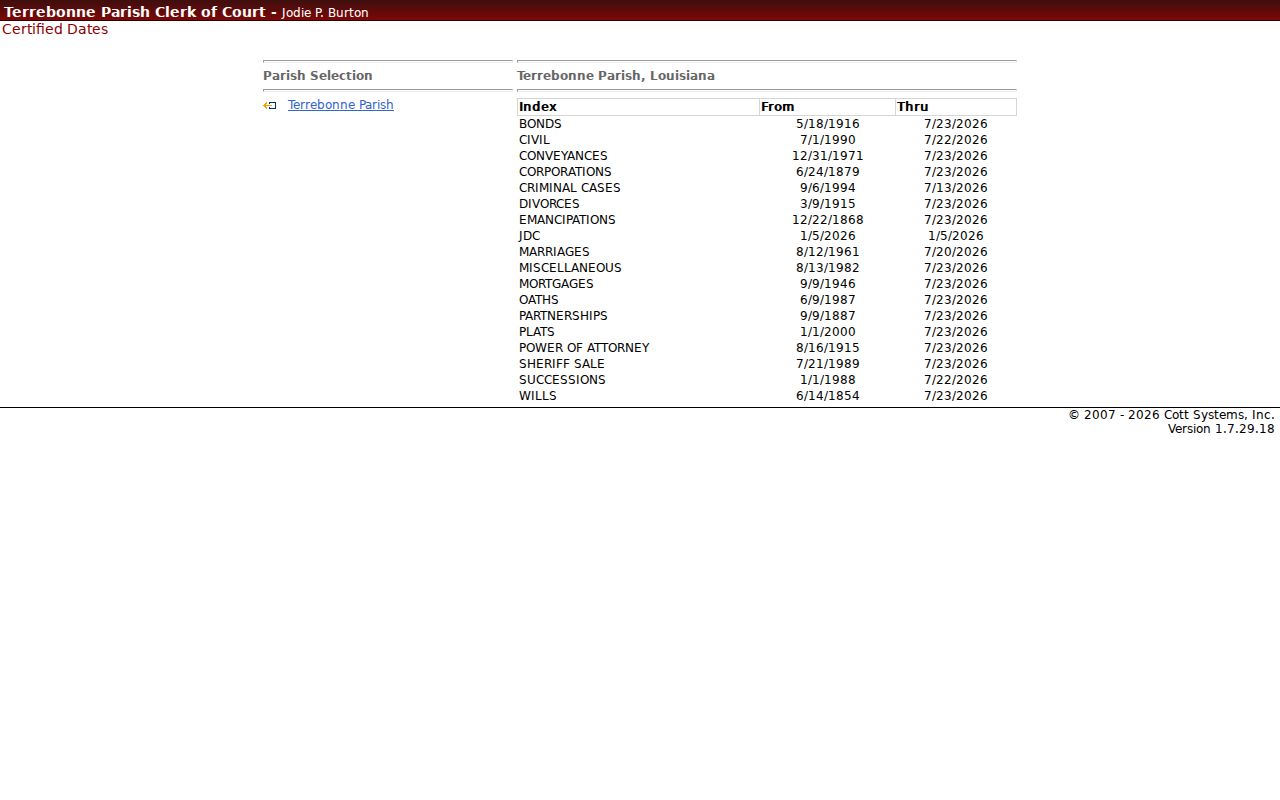
September 6, 1994 is the key boundary for the clerk's online criminal index. The Certified Dates page states when searchable coverage begins and how current the certified index is. A case before that date may still exist even when an online name search returns nothing. Older files may sit on earlier media and need staff assistance.
The clerk's coverage screen supplies the date context that a bare no-result message cannot.
Call 985-868-5660 with the name, approximate year, and docket number if known. Ask about the division, image availability, copy cost, and certification cost before traveling. The criminal-record counter is in the I. Robert “Bobby” Boudreaux Courthouse Building, 7856 Main Street, Houma, Louisiana 70360.
Note: An empty online result does not prove that no Terrebonne Parish criminal case exists.
Inside a Terrebonne Parish Case File
A criminal case file records what prosecutors filed and what the court did. That makes it different from a booking entry, which reports arrest-stage charges. The filed charge may be amended, reduced, dismissed, or resolved through a plea or trial. Read the disposition for each count instead of treating the caption or first charge as the final outcome.
| Case Number & Court | Docket number, State of Louisiana caption, filing date, division, and status. |
|---|---|
| Charging Document | Complaint, bill of information, or indictment, with statutes and separate counts. |
| Docket Entries | Minute entries, motions, continuances, capias activity, and filed-document metadata. |
| Hearing Dates | Arraignment, motion, trial, plea, sentencing, and later review settings. |
| Disposition & Judgment | Guilty or no-contest plea, dismissal, nolle prosequi, acquittal, or other outcome by count. |
| Sentence & Conditions | Confinement, probation, fines, costs, restitution, and concurrent or consecutive terms. |
Reading Terrebonne Criminal Dispositions
“Disposition” means the result of a charge. A nolle prosequi is the prosecutor's formal choice not to continue it. A dismissal ends the charge without a conviction, while an acquittal is a not-guilty result after adjudication. A guilty plea, no-contest plea, or guilty verdict can produce a conviction and sentence. Because one case may contain several counts, each count can have a different result.
- Arraignment
- The hearing where the filed charge is read and a plea is entered.
- Capias
- A court order directing arrest, often after a failure to appear or comply.
- Minute entry
- The clerk's record of what occurred during a court event.
- Restitution
- Court-ordered payment for a qualifying victim loss, separate from fines and costs.
When a Louisiana Computerized Criminal History record lacks the final result, obtain an original, unaltered certified court or district-attorney document. LSP matches the name, birth date, arrest date, original charges, amended charges, verdict, and sentence. The clerk's certified outcome can therefore correct a state chronology that still shows only an arrest cycle.
How a Criminal Case Moves
After arrest and booking, the district attorney screens the facts and decides which charge, if any, to file. A bill of information is common for Louisiana charges; a grand jury may return an indictment. Arraignment follows. Discovery, motions, and continuances then build the docket. The matter may end through dismissal, a plea, or trial, followed by judgment and sentence when there is a conviction.
Case flow: Charges Filed › Arraignment › Pretrial › Plea or Trial › Disposition › Sentencing
Appeal, probation action, revocation, and later expungement can add entries long after sentencing. No single time estimate applies to all Terrebonne Parish cases, and the research does not publish a local average. The docket's next setting and minute entries provide the most reliable case-specific timeline.
Terrebonne Courtroom Roles and Records
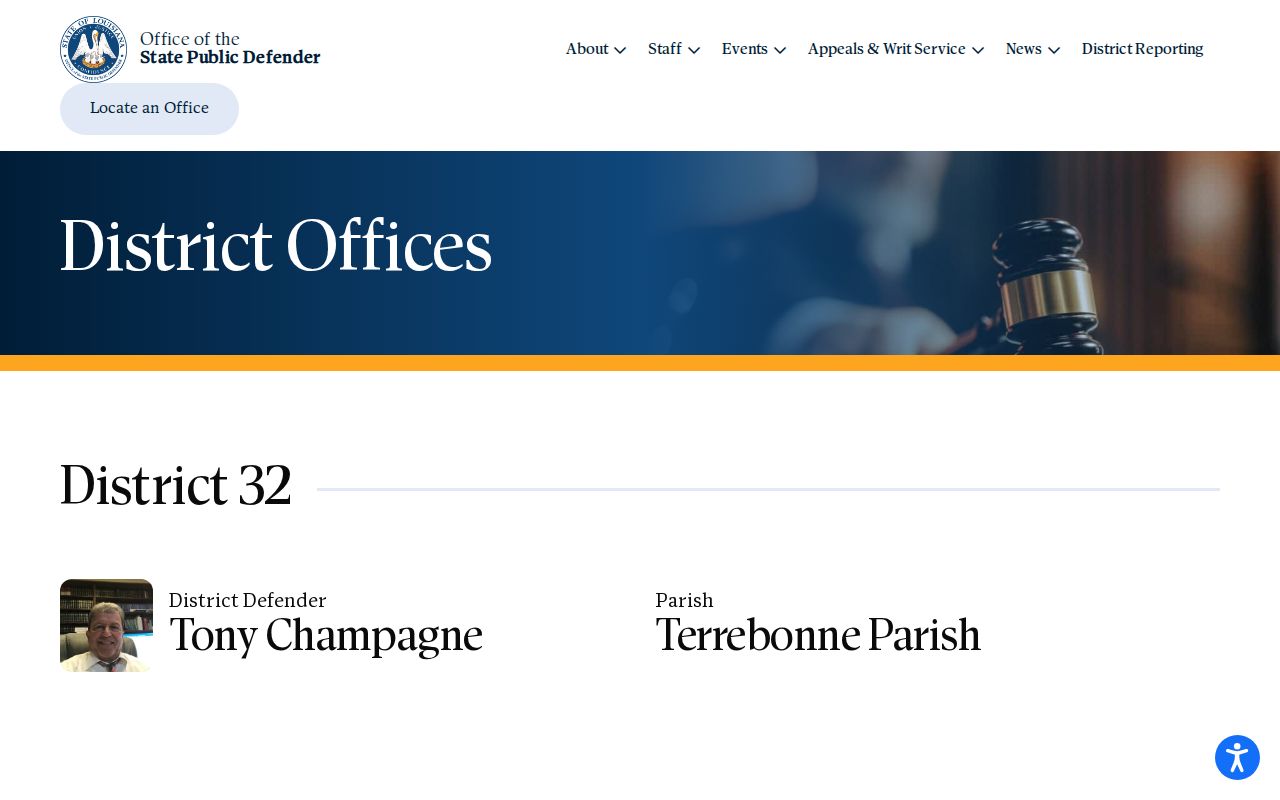
The clerk preserves the court file, but other offices create parts of the case. The 32nd Judicial District Attorney decides what the state prosecutes. Defense counsel files motions and represents the accused. The District 32 Public Defender office, at 504 Belanger Street in Houma, serves eligible defendants; it is not the public court-record custodian. The court decides motions, accepts pleas, conducts trials, and imposes sentences.
The state public defender directory confirms the local office connected with Terrebonne Parish criminal cases.
For a copy of a filed motion or minute entry, contact the clerk rather than counsel. For legal advice or representation, a court-record request is not a substitute for speaking with a lawyer.
Terrebonne Booking Charges Versus Filings
A Terrebonne Parish arrest lookup can show the charge stated at booking, custody, and bond. It cannot establish what the district attorney later filed. The criminal docket is the better record for the prosecuting charge and result. Louisiana's fingerprint-built LACCH chronology is a third layer, and the public cannot buy a general name search from that closed state repository.
| Source | Best For | Key Limit |
|---|---|---|
| TPSO booking record | Arrest-stage charge, custody, and bond | Does not prove filing or conviction |
| Clerk criminal docket | Filed charge, hearings, disposition, and sentence | May require sign-in, payment, or staff help |
| LACCH Right to Review | A person's own fingerprint-linked Louisiana history | Not a public name-search product |
Case Record Access & Restrictions
The Louisiana Public Records Law supports access to nonexempt government records, but a request to an executive agency is not a substitute for ordering a judicial case copy from the clerk. Public court views may omit full birth dates, Social Security numbers, financial identifiers, protected victim or minor data, and sealed documents. Juvenile material and qualifying expunged records are not ordinary public search results.
Louisiana expungement under Code of Criminal Procedure article 971 removes qualifying material from public access without destroying it. Authorized justice agencies retain access. A gap can also reflect an old file, a portal image restriction, or a misspelled name, so do not assume a sealed case from the absence alone. Ask the clerk whether a public record exists and what proof is needed for a certified copy.
Verify the outcome: An arrest is not a conviction. Match every Terrebonne Parish charge to its own disposition and confirm important results with the originating court.